Graphical Lasso
The graphical lasso learns a GMRF from data by estimating a sparse precision matrix. Given a data matrix
where
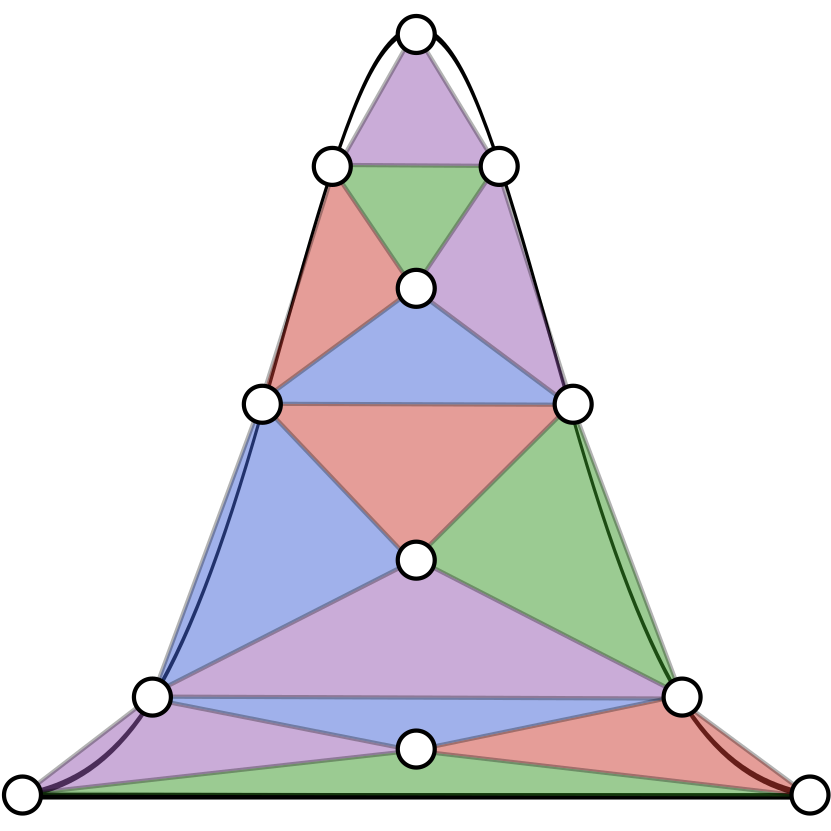
The implementation follows the approach of [4], which combines soft-thresholding of the sample covariance with a maximum-determinant positive-definite matrix completion via chordal graph techniques (using CliqueTrees.jl).
Restricted Graphical Lasso
Instead of a scalar threshold
API Reference
GaussianMarkovRandomFields.graphical_lasso Function
graphical_lasso(X::AbstractMatrix, threshold; blocksize::Int=256, shift=zero(T), alg=nothing)Learn a GMRF from data by solving the graphical lasso problem:
maximize  log det Ω - tr(ΣΩ) - λ ‖Ω‖₁
such that  Ω is positive definite
where Σ is the sample covariance and Ω is the GMRF's precision matrix.
threshold can be a scalar λ for uniform penalization, or a SparseMatrixCSC for per-entry penalties within a given sparsity pattern (restricted graphical lasso).
shift adds a constant to the diagonal of the sample covariance as regularization to improve convergence.