Notation
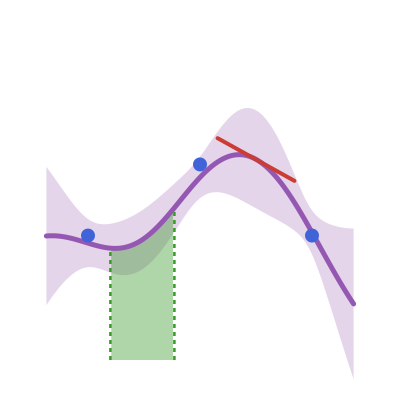
The FunctionalGPs.Notation submodule provides math-flavoured aliases for the common linear functionals and operators. It is opt-in — load it explicitly when you want construction of a FunctionalGaussian to read like the math:
using FunctionalGPs, FunctionalGPs.Notation

fg = FunctionalGaussian(f;
    y  = δ(X_obs),
    dy = δ(X_pred) ∘ ∂(1),
    q  = ∫([Interval(0.0, 1.0)]),
)| Symbol | Equivalent to | Meaning |
|---|---|---|
δ(X) | EvaluationFunctional(X) | Point evaluation (Dirac) |
δ(x::Real) | EvaluationFunctional([x]) | Single-point evaluation |
∂(i::Integer) | PartialDerivative((i,)) | First-order partial in 1D — ∂/∂xᵢ |
∫(args...) | VectorizedLebesgueIntegral(args...) | Lebesgue integral over one or more domains |
Higher-order and higher-dimensional partials
∂ is intentionally restricted to a single integer argument because PartialDerivative uses a multi-index where the tuple position encodes the dimension and the value encodes the per-dimension order. A single ∂(i) matches only the unambiguous 1D case. For higher orders or higher dimensions, use the multi-index form directly:
PartialDerivative((2,))     # ∂²/∂x₁² in 1D
PartialDerivative((1, 0))   # ∂/∂x₁ in 2D
PartialDerivative((1, 1))   # mixed ∂²/∂x₁∂x₂ in 2D
Composition does not fold: ∂(1) ∘ ∂(1) builds a ConcatenatedLinearFunctionOperator, not PartialDerivative((2,)). They are equivalent in value but not in type. Prefer the multi-index form when you mean a higher-order partial.
Conflicts
∂ is exported by neither Symbolics nor ModelingToolkit, so loading those packages alongside FunctionalGPs.Notation does not produce a clash. Differential from those packages is deliberately not aliased here.