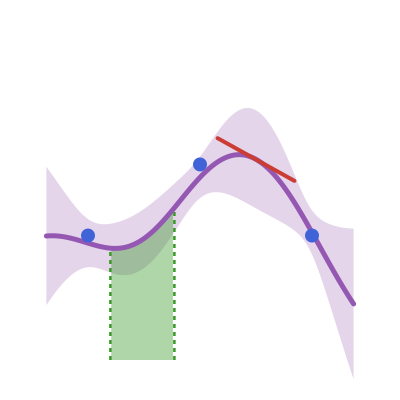
Getting Started
Welcome! This page walks you through FunctionalGPs.jl from a fresh REPL to a GP posterior conditioned on a mix of point, derivative, and integral observations — in about five minutes.
Why FunctionalGPs.jl?
Real measurements rarely come as clean point values of the latent function:
A weather station reports an integral: average temperature over the past hour, not the instantaneous value.
A wind sensor reports a derivative: the gradient of pressure, not its height.
A satellite tile reports a cell average over a box: the integral of reflectance over the pixel footprint.
A physical model imposes conservation laws — equations on derivatives of the latent field that hold at every point in the domain.
All of these are linear functionals of the unknown function. Gaussian processes are closed under linear functionals: if f ~ GP(m, k) then ℒ(f) is multivariate Gaussian for any linear ℒ, and you can write down the cross-covariance between any two functionals in closed form.
FunctionalGPs.jl makes this composable. You build functionals out of three primitives — point evaluation δ, partial differentiation ∂, and Lebesgue integration ∫ — and combine them with three operators:
∘composes a functional with a differential operator (δ ∘ ∂x),+and-linearly combine functionals,⊗builds tensor products for axis-separable domains.
The library handles the cross-covariance assembly, the matrix algebra, and — under the hood — dispatches to specialised paths (Toeplitz matrices for stationary kernels on regular grids, sparse matrices for compactly supported kernels, closed-form antiderivatives for half-integer Matérns) so you don't have to hand-roll anything for the common cases.
Installation
FunctionalGPs.jl is available in the Julia General registry:
using Pkg
Pkg.add("FunctionalGPs")
This is an alpha release: the API will change. Pin a specific version if you need reproducibility.
Your first mixed-observation GP
Suppose the latent function is f(x) = sin(2πx) on [0, 1], and you have three kinds of observations:
Point values of
fat a handful of locations,Derivative values
f'(x)at a couple of locations,Integral values
∫_a^b f(x) dxover a few sub-intervals.
You don't know which kind of observation is which "more informative" — the right thing is to condition on all of them jointly.
using FunctionalGPs
using AbstractGPs
using Random

f_true(x)  = sin(2π * x)
f_deriv(x) = 2π * cos(2π * x)

Random.seed!(0)

# A Matern 5/2 prior with lengthscale 0.2.
ℓ = 0.2
k = HalfIntegerMaternKernel(2, [ℓ])
f = GP(k)

# --- Three kinds of observations -----------------------------------------

# Point observations
X_pts = [0.05, 0.30, 0.55, 0.80, 0.95]
y_pts = f_true.(X_pts) .+ 0.02 .* randn(length(X_pts))
δ_pts = EvaluationFunctional(X_pts)
obs_pts = LinearObservation(δ_pts, y_pts; noise = 0.02^2)

# Derivative observations  ( ℒ = δ ∘ ∂x )
X_der = [0.15, 0.45]
y_der = f_deriv.(X_der) .+ 0.05 .* randn(length(X_der))
∂x = PartialDerivative((1,))
ℒ_der = EvaluationFunctional(X_der) ∘ ∂x
obs_der = LinearObservation(ℒ_der, y_der; noise = 0.05^2)

# Integral observations over two sub-intervals
intervals = [Interval(0.0, 0.5), Interval(0.5, 1.0)]
y_int = [0.0, 0.0]   # ∫₀^½ sin(2πx) dx = 1/π  ≈ 0.318
                     # ∫_½¹ sin(2πx) dx = -1/π ≈ -0.318
y_int .= [1/π, -1/π] .+ 0.01 .* randn(2)
ℒ_int = IntegralFunctional(intervals)
obs_int = LinearObservation(ℒ_int, y_int; noise = 0.01^2)
Condition the GP on all three observation types — order does not matter, each call returns a posterior GP you can keep conditioning on:
f_post = condition_on_observation(f, obs_pts)
f_post = condition_on_observation(f_post, obs_der)
f_post = condition_on_observation(f_post, obs_int)
Predict and evaluate:
X_test = range(0, 1; length = 101)
μ, σ² = mean_and_var(f_post(collect(X_test)))
That's it — μ is the posterior mean, σ² is the posterior variance, and f_post behaves like any other AbstractGPs posterior: you can sample from it, push it through another functional, condition it on more data, and so on.
What just happened?
The library walked through the composition you wrote and assembled the joint covariance between every pair of observations:
δ_pts(δ_pts(k))— the standard kernel matrix.(δ ∘ ∂x)(δ_pts(k))— derivative-vs-point cross-covariance, built from the analytic derivative of the Matérn kernel.ℒ_int(δ_pts(k))— integral-vs-point cross-covariance, built from the closed-form radial antiderivative of the Matérn kernel.ℒ_int(ℒ_int(k))— integral-vs-integral covariance, double-integrated via the same antiderivative chain.
For stationary kernels on regular grids, those matrices come back as lazy Toeplitz objects; for compactly supported kernels they come back sparse. You don't see this on the surface, but it's why mixing observation types is practical at non-trivial sizes.
Next steps
For models where you need the joint Gaussian over several named functionals of the same GP — e.g. inside a Turing or DynamicPPL model for hyperparameter sampling — see Joint Functional Gaussians.
For the math-flavoured shorthand (
δ,∂,∫), see Notation.For the full set of functionals, operators, and composition rules, see the Functionals API reference.
For the trait system that drives the fast paths under the hood, see Specializations.